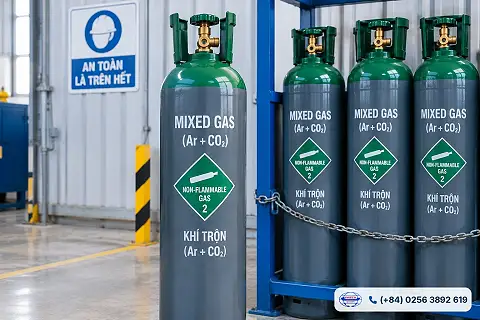

Ar + CO₂ mixtures in MIG/MAG welding: when should you use them instead of pure CO₂?
A comparison of pure CO₂ and argon – CO₂ mixtures as shielding gases in terms of weld quality, spatter and cost, to help workshops choose the right gas.
In MIG/MAG welding, the shielding gas prevents air from reaching the molten weld pool. The choice of gas directly affects penetration, weld profile, spatter and productivity. The two most common options today are pure CO₂ and argon – CO₂ mixtures.
Pure CO₂
- Low gas cost, easy to source, suitable for ordinary carbon steel welding.
- Deep penetration, suitable for thick materials.
- Less stable arc, more spatter and more time spent cleaning after welding.
- Rougher weld surface than with gas mixtures.
Argon – CO₂ mixtures
- For carbon steel, the usual ratio is about 80 – 82% argon and 18 – 20% CO₂.
- Smooth, stable arc with significantly less spatter.
- Neat, even welds that need little grinding, saving finishing labour.
- Enables spray transfer welding, giving high productivity on medium-thickness materials.
Which option should you choose?
If your workshop mainly welds ordinary steel structures, prioritises cost and has no strict appearance requirements, pure CO₂ remains the economical choice. Conversely, for products that need clean welds with little spatter, or where post-weld grinding and cleaning make up a large share of costs, gas mixtures usually reduce the total cost despite the higher gas price.
Notes by welding material
- Stainless steel: usually argon with a small amount of CO₂ or oxygen (about 2%).
- Aluminium and aluminium alloys: use pure argon, never gases containing CO₂.
- TIG welding: use pure argon for most materials.
INSECO supplies gas mixtures in the required ratios, from cylinders and cylinder bundles to vessels and storage tanks. Call our hotline +84 256 3892 619 for advice on the right ratio for your materials and welding equipment.
Need advice on industrial or medical gases?
The INSECO technical team is ready to help and provide a quick quotation.


