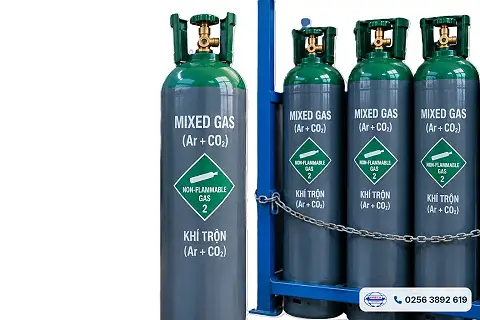

What are gas mixtures? Common types and how to choose the right one
Gas mixtures are blends of two or more gases in precise ratios for specific purposes: welding, food preservation and laboratories. Learn about the common types, how they are blended and what to consider when choosing and using them.
A gas mixture is a blend of two or more gases in a set ratio to achieve properties that no single gas can provide. For example, argon gives a stable arc but shallow penetration, while CO₂ penetrates deeply but causes a lot of spatter; mixing the two in the right ratio combines the advantages of both.
Gas mixtures for welding
- Argon + CO₂: the most common mixture for MIG/MAG welding of carbon steel, usually about 80 – 82% argon and 18 – 20% CO₂; neat welds with little spatter.
- Argon + oxygen or argon + a small amount of CO₂ (about 2%): used for welding stainless steel, giving a stable arc and good wetting.
- Argon + helium: used for thick aluminium and copper, giving a hotter arc, deeper penetration and faster welding.
Gas mixtures in food and laboratories
- Food preservation: nitrogen + CO₂ mixtures are flushed into packaging to limit bacteria, mould and oxidation and extend shelf life.
- Laboratories and testing: standard gases of known composition are used to calibrate analysers, sensors and gas detectors.
How are gas mixtures blended?
Gas mixtures are blended by adding each component to the cylinder in turn by a calculated weight or pressure, then homogenising the mixture and checking its composition. Each cylinder is labelled with the mixture name and ratio. Using premixed gas keeps the composition consistent from cylinder to cylinder, with no need to invest in on-site mixing equipment.
Choosing the right mixture
- Be clear about the purpose: the material and welding process, the type of food to preserve or the instrument to calibrate.
- State your consumption to choose the right cylinder size: 3 m³ (20-litre) for small demand, 6 m³ (40-litre) for regular use.
- Check that the cylinder label shows the correct mixture name and ratio before connecting it to the equipment.
Safety precautions
- Keep cylinders upright, securely strapped, with the valve cap fitted.
- Use the correct pressure regulator and flow meter.
- Although non-flammable, gas mixtures can cause asphyxiation in enclosed spaces by displacing oxygen.
- Check for leaks with soapy water.
- Never blend gases yourself by connecting cylinders together: the ratio is easily wrong and it can be unsafe.
INSECO supplies gas mixtures blended to customer-specified ratios, in 3 m³ (20-litre) and 6 m³ (40-litre) cylinders. Call our hotline +84 256 3892 619 for advice on the right ratio for your materials and equipment.
Need advice on industrial or medical gases?
The INSECO technical team is ready to help and provide a quick quotation.


