
Gaseous and liquid CO₂: applications in welding, food and water treatment
CO₂ is used in many industries: as a welding shielding gas, for carbonating drinks, preserving food, fighting fires and adjusting water pH. This article covers its properties, applications and safety precautions.
Carbon dioxide (CO₂) is a colourless, non-flammable gas about 1.5 times heavier than air. Unlike oxygen, nitrogen or argon, CO₂ liquefies easily when compressed at ordinary temperatures, so inside a cylinder it exists as liquid at the bottom with gas above. That is why CO₂ is usually measured by weight (kg) rather than by volume (m³).
Industrial applications
- Shielding gas for MIG/MAG welding of carbon steel: low cost and deep penetration; used on its own or mixed with argon.
- Gas supply for CO₂ fire extinguishers, which put out fires by diluting oxygen and leave no residue, making them suitable for electrical panels and machine rooms.
- Water treatment: adjusting the pH of wastewater and process water, safer to handle than strong acids.
- Raw material for dry ice (solid CO₂) used in cold storage and industrial cleaning.
Food and beverage applications
- Carbonating soft drinks, beer and sparkling mineral water.
- Modified atmosphere packaging (MAP): CO₂ is often combined with nitrogen to inhibit bacteria and mould and extend shelf life.
- Freezing and rapid chilling of food with liquid CO₂ or dry ice.
- Applications in contact with food should use high-purity CO₂ with clear quality documentation.
Gaseous or liquid CO₂?
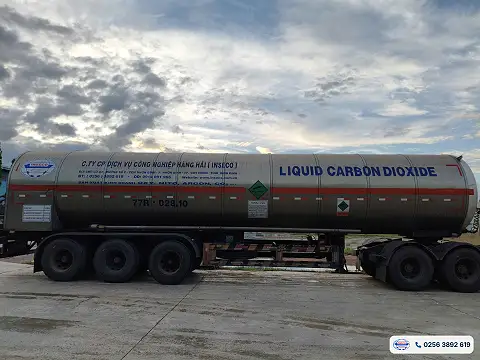
Small to medium users can choose 20-litre (12.5 kg) or 40-litre (25 kg) cylinders or cylinder bundles. Plants with large, continuous demand should use liquid CO₂ supplied in XL45 vessels (about 200 kg) or storage tanks from 1 m³; liquid CO₂ from the tank is vaporised and fed into the pipeline, keeping the supply stable and cutting the time spent on cylinder changes.
Safety precautions
- CO₂ is heavier than air and collects in pits, trenches and closed stores; at high concentrations it causes headaches, breathing difficulty and asphyxiation. Always ensure good ventilation.
- When released quickly, CO₂ expands and becomes very cold, which can cause cold burns and freeze the regulator: wear protective gloves and choose a heated regulator for high flow rates.
- Store cylinders in a cool, shaded place, as heat raises the pressure inside sharply.
- Use valves, hoses and accessories designed for CO₂.
INSECO operates gas and liquid CO₂ supply lines at its Quang Ngai Branch and Long My Plant (Quy Nhon), serving businesses and factories in Central Vietnam and the Central Highlands. Call our hotline +84 256 3892 619 for advice.
Need advice on industrial or medical gases?
The INSECO technical team is ready to help and provide a quick quotation.


