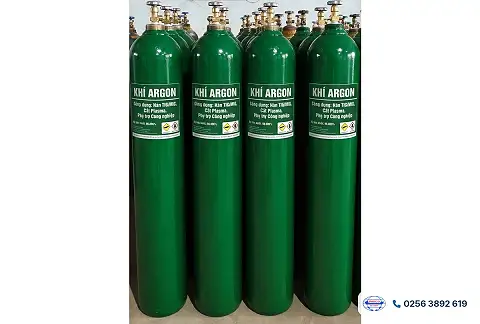

Argon (Ar): why is it the go-to shielding gas for TIG and MIG welding?
Argon is an inert gas that does not react with molten metal, which makes it a widely used shielding gas in welding. Learn about its properties, applications and how to choose the right argon for your materials and equipment.
Argon (Ar) is a noble gas that makes up almost 1% of the air. It is colourless, odourless, non-flammable and heavier than air. Argon is separated from air by low-temperature distillation, in the same process that produces oxygen and nitrogen. Its most important property is chemical inertness: even at very high temperatures, it hardly reacts with metals.
The role of shielding gas in welding
During welding, molten metal readily reacts with oxygen, nitrogen and moisture in the air, causing porosity and slag inclusions and leaving the weld brittle and weak. Shielding gas is blown through the torch to push air away from the weld zone. With argon, the weld pool is surrounded by a layer of inert gas, giving a clean weld with few defects.
Main applications of argon
- TIG welding: argon is used for most materials, including stainless steel, aluminium, copper and titanium.
- MIG welding of aluminium and its alloys: argon is used, never gases containing CO₂.
- The main component of gas mixtures for MIG/MAG welding of steel (argon + CO₂), giving a smooth arc with little spatter.
- Metallurgy, heat treatment and creating an inert atmosphere in production.
- Manufacturing electronic components and light bulbs, and use in spectroscopic analysers (with high-purity argon).
Industrial or high-purity argon?
For most welding work in mechanical workshops and steel fabrication, industrial argon is entirely adequate. Applications that demand high-quality welds, such as stainless steel or titanium for food and pharmaceutical equipment, or use in analytical instruments, call for high-purity argon. The exact purity should be advised according to the materials and equipment used.
Supply options
Gaseous argon is supplied in 3 m³ (20-litre) and 6 m³ (40-litre) cylinders, suitable for small and medium welding shops. Users with large, continuous demand can switch to liquid argon supplied in XL45 vessels (175 litres) or storage tanks from 1 m³ with a vaporiser.
Safety precautions
- Argon is heavier than air and can accumulate in pits, trenches and low-lying areas, causing asphyxiation: ensure good ventilation when welding in confined spaces.
- Use a regulator with a flowmeter suitable for argon to set the shielding gas flow accurately and avoid waste.
- Secure cylinders firmly, fit the valve cap during transport and close the valve after use.
- Liquid argon is extremely cold: wear gloves and safety glasses when handling it.
INSECO supplies gaseous and liquid argon, as well as argon – CO₂ mixtures in the required ratios, to welding and metalworking shops in Central Vietnam and the Central Highlands. Call our hotline +84 256 3892 619 for advice.
Need advice on industrial or medical gases?
The INSECO technical team is ready to help and provide a quick quotation.


